1
2
3
4
5

Let’s get to know you:

2
3
4
5

Where is your primary residence?

3
4
5

How May We Reach You?

4
5

Did Someone Refer You to Bull Run?

5

What is the Approximate Amount of Your Investable Assets?

Thank you! Your submission has been received!
Oops! Something went wrong while submitting the form.
Key Takeaways

    Six million children are already enrolled in the new “Trump Accounts” created by last year’s One Big Beautiful Bill Act — including 1.4 million eligible for a $1,000 federal head start. Here’s how the accounts work, how they fit alongside 529s and custodial Roths, and what maxing one out could mean for your child.

    There’s a Warren Buffett line we find ourselves reaching for in almost every planning conversation with young families:

    Someone’s sitting in the shade today because someone planted a tree a long time ago.
    Warren Buffett

    For most parents and grandparents, that’s the whole point of saving, investing, and planning: the financial security of the next generation. Alongside the day-to-day costs of raising children, families have to prepare for the big ones — childcare, healthcare, education — while also trying to give their kids a genuine head start. The good news is that the menu of ways to do it just got bigger.

    01 · The New Account

    A retirement account for kids — with a $1,000 head start

    The One Big Beautiful Bill Act created a new savings vehicle under Section 530A of the tax code — commonly known as “Trump Accounts.” The simplest way to think about them: an individual retirement account built for children. Growth is tax-deferred, the investment menu is deliberately simple, and — for qualifying children — the federal government makes the first contribution for you.

    $1,000
    Federal Pilot Contribution
    Children Born 2025–2028
    0
    Children Already Enrolled
    Per The U.S. Treasury
    $5,000
    Annual Contribution Limit
    Aggregate, All Sources

    According to the Treasury Department, six million children are already signed up, with 1.4 million eligible for the $1,000 pilot contribution. As with any brand-new vehicle, the rules come first — here’s what matters:

    The $1,000 seed
    Children born between January 1, 2025 and December 31, 2028 who are U.S. citizens with a valid Social Security Number qualify for the federal pilot contribution — built-in motivation to start saving early.
    No earned income needed
    Unlike a custodial Roth IRA, contributions don’t require the child to have earned income. That creates a genuine alternative for long-term savings that aren’t earmarked for education.
    Five funds — that’s the menu
    Treasury has approved exactly five low-cost index ETFs — no individual stocks, no active funds. At launch, every contribution defaults into SPYM (SPDR Portfolio S&P 500); electing among the other four arrives in the coming months. Full lineup in the table below.
    Zero tax drag while it grows
    Nothing is taxed year to year — no tax on dividends, no capital gains as the fund compounds. Growth is tax-deferred until money comes out: after-tax contributions return untaxed, while earnings and the $1,000 seed are taxed as ordinary income at withdrawal. Contrast a UTMA, where the kiddie tax can bite annually.
    Locked until 18
    Funds are unavailable for withdrawal until the child turns 18 — so unlike a 529, a Trump Account can’t be used to pay for K–12 education.
    IRA rules after 18
    Once the child turns 18, withdrawals follow general IRA rules — including a 10% penalty on early withdrawals that don’t meet a qualifying reason.
    Contribution limits
    Individuals and employers combined can contribute up to $5,000 per year, and employers can add up to $2,500 annually without that amount counting as taxable income to the employee.
    FundTickerTracksStatus
    State Street SPDR Portfolio S&P 500SPYMS&P 500Default — all contributions at launch
    iShares Core S&P 500IVVS&P 500Electable in the coming months
    Vanguard Total Stock MarketVTITotal U.S. marketElectable in the coming months
    State Street SPDR Portfolio S&P 1500 CompositeSPTMS&P Composite 1500Electable in the coming months
    iShares Core S&P Total U.S. Stock MarketITOTS&P Total MarketElectable in the coming months

    That’s the entire menu, per Treasury’s July 1 lineup announcement. Statutory guardrails on every fund: unleveraged, at least 90% U.S. companies, expense ratios under 0.10%, and no cash or money-market options (investor.gov · State Street). Official program hub: trumpaccounts.gov.

    It’s best to think of a Trump Account as a complement to the rest of the toolkit rather than a substitute for it — the most effective financial strategy is rarely built around a single account. But before we get to the toolkit, let’s answer the question every parent asks first: what could this actually become?

    02 · Make It Personal

    What could your child’s account actually become?

    One of the oldest principles in investing is that time matters more than timing. Clearnomics ran the math on a single $1,000 invested at different starting ages, and the result is striking: postponing that one investment by just five years costs $3,064 in forgone gains at a 7% compound return. Now scale that idea up to a fully funded Trump Account. Set your child’s age and your annual contribution below — the projection updates the moment you move a slider.

    A quick reality check before you play with it. Until your child turns 18, the menu is what you just saw: five Treasury-approved index ETFs, with every dollar defaulting into SPYM at launch. So the first row of buttons is the real menu — and each fund runs at its own real annualized total return, computed from the five funds’ common trading history (November 2005 through July 2026, dividends reinvested). The quiet kicker is the second row: the year your child turns 18, the account converts to IRA rules — and the menu opens up. That’s the moment a strategy like BRIM’s can take over. Toggle one and watch what the switch adds.

    BRIM Interactive · Hypothetical Illustration
    The Trump Account Illustrator
    The $1,000 pilot goes to children born 2025–2028 who are U.S. citizens with a Social Security Number — it’s added automatically when the birth year qualifies. Contributions run through the year your child turns 17, compounding the whole way with zero tax drag. At 18 the account converts to IRA rules — that’s what the “after 18” row is for: choose where it grows from there and see the total, whether you stay indexed or make the switch.
    0
    $5,000
    Your fund until 18 ·
    After 18 · IRA rules open the menu
    All five approved ETFs track broad U.S. stock indexes, so the projection models them at the U.S. market’s live annualized compound return since Jan 2008. The after-18 options apply a BRIM strategy’s live annualized compound over the same period — net of our maximum retail fee, and including backtested results. Every rate is recalculated from our master performance database on each page load — never stale · data through .
    In 10 Years
    In 20 Years
    In 30 Years
    In 40 Years
    In 50 Years
    Total contributed: Hypothetical growth: Value in 50 years:
    Hypothetical illustration — assumptions & methodology

    Hypothetical illustration only — not a projection or guarantee. Assumes contributions at the start of each year through age 17 at the amount shown (max $5,000/yr under current law) and a constant growth rate within each phase, with no taxes or trading costs layered on top. Each approved ETF is modeled at its own annualized total return (dividends reinvested), computed from adjusted closing prices over the five funds’ common trading history — November 15, 2005 through July 16, 2026 — via Tiingo market data, as of July 2026; fund expense ratios (capped below 0.10%) are not deducted. The after-18 toggle is a hypothetical: once IRA rules apply, the balance could move to strategies like BRIM’s, whose rates include backtested results and are net of BRIM’s maximum retail advisory fee (1.50% annually), covering the backtested + live period since January 2008. No constant multi-decade rate matches a real investment path, and high historical rates are especially unlikely to persist. Past performance does not guarantee future results. See disclosures below.

    Thirty seconds of sliding tells you everything: the edge isn’t any single input — it’s time, compounding untouched. Which leaves only the practical question: how do you actually get one open? That part, we made even easier.

    Ready when you are · takes about 20 seconds
    Open a Trump Account with BRIM
    Wondering if it’s really this easy? It is. Leave your name and how many kids you’re opening accounts for — Chris gets your note the moment you hit submit, and personally handles the rest: paperwork, funding, the $1,000 pilot, and getting it invested.
    No obligation, and nothing gets opened yet — submitting simply asks BRIM to reach out to you about a Trump Account.
    Want the custodian’s take first? Read Schwab’s explainer ↗ · Prefer to talk it through? Book a call with Chris ↗

    The exact numbers will depend on markets, contribution discipline, and time — but the shape of the outcome never changes. Every year of delay removes the best compounding year your child will ever have: the last one. The principle generalizes well beyond Trump Accounts:

    The Importance of Saving Early — value at age 65 of an initial $1,000 investment by starting age and compound return
    The value at 65 of a single $1,000 investment, by starting age and rate of compounding. Postponing by five years forgoes $3,064 at 7%. Framework: Clearnomics.
    03 · The Full Toolkit

    One account rarely does it all

    Child savings accounts have quietly become a core component of American financial plans. According to Congressional data, the number of children with dedicated savings accounts more than quadrupled in just two years:

    0M
    Children with dedicated savings accounts as of 2023 — up from 1.2 million in 2021, per Congressional Research Service data.

    Which vehicle — or, more often, which combination — makes sense depends on your circumstances, goals, and liquidity needs. The four workhorses, side by side:

    AccountBuilt ForEarned Income?Annual LimitTax Treatment
    Trump Account (530A)Retirement head startNot required$5,000 aggregateAfter-tax in; IRA rules after 18
    529 PlanEducationNot requiredGift-tax limitsAfter-tax in; tax-free for qualified education
    Custodial Roth IRARetirementRequired$7,500 (2026)After-tax in; tax-free out if conditions met
    UGMA / UTMAGifting & inheritanceNot requiredGift-tax limitsAfter-tax; child owns at legal age

    Simplified summary for comparison. Contribution rules, tax treatment, and financial-aid impact depend on individual circumstances — see disclosures.

    A few distinctions worth underlining. A 529 is typically opened by a parent or grandparent and is laser-focused on education: contributions are after-tax and withdrawals are tax-free when used for qualified education expenses. A custodial Roth IRA is held in the minor’s name and geared toward retirement — but the child must have earned income to contribute, which is precisely the requirement a Trump Account removes. And UGMA/UTMA accounts are owned by the minor, managed by a custodian, and exist primarily for gifting and inheritance — maximum flexibility, minimum tax advantage.

    All four can coexist inside one plan. The real question is sequencing: which dollars go where first, given what you want for education, flexibility, and retirement.

    04 · Maximizing It

    Three strategies — and one pitfall

    Once the accounts are open, a handful of moves can meaningfully change the math — and one common oversight can quietly undo it:

    Superfund the 529
    Individuals can front-load a lump sum of up to $95,000 per beneficiary in a single year — a five-year gift election — without triggering gift tax. A bonus worth remembering: parent-owned 529s are not counted as student assets when calculating federal financial-aid eligibility.
    Gift appreciated stock
    Transferring highly appreciated securities into an UTMA and selling them as long-term gains at the child’s rate can — depending on the parents’ income level — reduce or even avoid capital gains taxes. The trade-off: UTMA assets do count as the student’s for federal aid, and student assets are weighed more heavily in the formula.
    Layer the accounts
    The Trump Account for the retirement head start, the 529 for education, the UTMA for flexible gifting — each dollar assigned to the vehicle whose rules match its job. Complementary, not competing.
    The kiddie-tax pitfall
    A child’s unearned income is exempt only up to a threshold: below it, investment income is taxed at the child’s rate; above it, at the parents’ marginal rate. That applies to earnings inside an UTMA — and to distributions from a Trump Account. Plan withdrawals with it in mind.
    05 · The Long Game

    Time is the most valuable asset your child owns

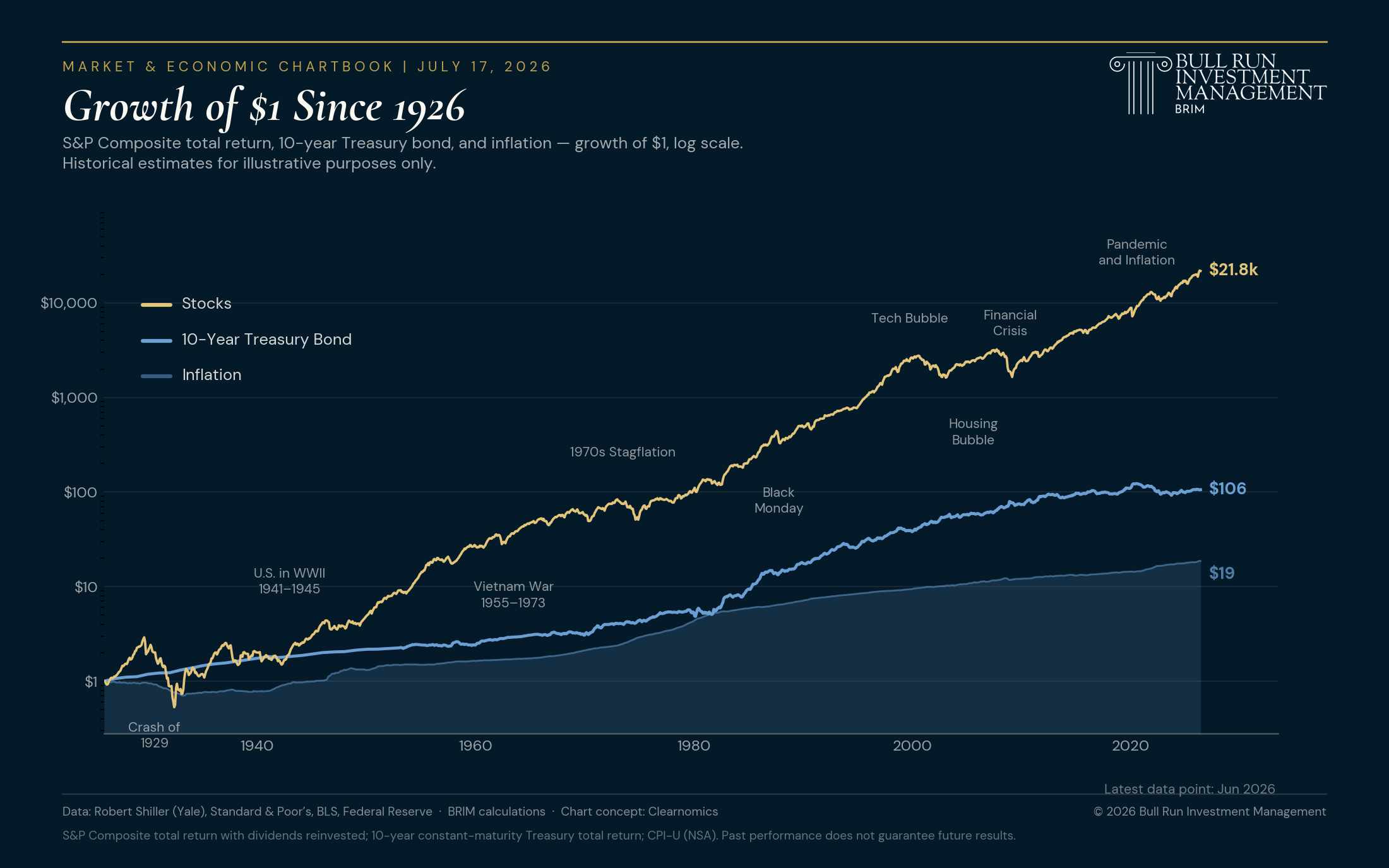
    Historically, even a small amount invested at birth can benefit enormously from compounding over a long horizon — which is exactly why the first principle of investing is to start as soon as possible. One dollar invested in U.S. stocks in 1926 has grown to roughly $23,000 today. The same dollar in 10-year Treasuries grew to $119. Left to inflation, it took $19 just to preserve the original dollar of purchasing power:

    $23k
    Growth Of $1 · U.S. Stocks
    1926 – June 2026
    $119
    10-Year Treasury Bond
    Same Dollar, Same Century
    $19
    Inflation
    Cost Of Standing Still
    Growth of $1 since 1926 — S&P Composite total returns, 10-Year Treasury bond, and inflation on a log scale
    S&P Composite total returns, 10-Year Treasury, and inflation on a log scale, 1926 – June 2026. Sources: Clearnomics, Robert Shiller, Standard & Poor’s, BLS.

    There’s a second, quieter benefit to all of this. Teaching children about saving and investing early — and letting them watch an account they know is theirs compound through their teens — is one of the most reliable ways to raise financially responsible adults. The account is the head start; the habit is the inheritance.

    A note for financial advisors

    If your clients with young families are asking about Trump Accounts, this framework is yours to borrow. And on the investment side, all four BRIM equity SMAs — Innovation, Growth, Core, and Low Volatility — are available to outside advisors through the Charles Schwab Managed Account Marketplace. Reach out and I’ll walk you through it.

    Christopher M. Passarelli
    Book a no‑obligation call with Chris

    Talk directly with the portfolio manager — not a sales team. We’ll walk through your goals and how our four proprietary SMA strategies fit.

    Book a Meeting
    Fee-only fiduciary · McLean, VA
    06 · Bottom Line

    The bottom line

    By planning ahead, parents can build a strong financial foundation for their children’s futures — and the toolkit for doing it just got bigger. A Trump Account won’t replace a 529 or a custodial Roth, but a $1,000 federal head start, a simple equity-index menu, no earned-income requirement, and up to $5,000 a year of tax-deferred compounding is a meaningful new option — especially for children born between 2025 and 2028, where the government has already made the first contribution for you.

    If you’d like to talk through whether a Trump Account belongs in your family’s plan — how to sequence it against a 529, a custodial Roth, or an UTMA, and what to hold inside each — that is exactly the conversation we’re built for. The math above only works one way: the sooner the tree goes in the ground, the longer the shade.

    And if this piece did its job, the next step takes twenty seconds: jump back up to the open-an-account form and put your name on it — Chris handles everything from there.

    Plant the tree.

    Go straight to the source
    Christopher M. Passarelli
    Meet the Author
    Founder, CEO & Portfolio Manager
    Chris Passarelli is the Founder, CEO, and Portfolio Manager of Bull Run Investment Management, a fee-only Registered Investment Adviser headquartered in McLean, Virginia. He manages four proprietary SMA strategies available on the Charles Schwab platform.
    View full profile
    Your Introduction

    Your introduction to Bull Run starts here.

    Schedule a complimentary, no-obligation call so we can understand your financial goals and show you exactly how our proprietary SMA strategies are managed — or send a note below and Chris will reach out directly.

    Christopher M. Passarelli
    Christopher M. Passarelli
    Founder, CEO & Portfolio Manager

    Submitting this form does not create an advisory relationship. No advice may be rendered by BRIM unless a client service agreement is in place.

    Important Disclosures. This material is for educational purposes only and does not constitute tax, legal, or personalized investment advice, nor a recommendation to open any particular account. The Trump Account Illustrator above is a hypothetical illustration: it assumes contributions are made at the start of each year through the year the child turns 17 at the amount selected, applies a constant user-selected annual rate of return, and does not reflect taxes, advisory fees, inflation adjustment of contribution limits, or actual investment performance; actual results will vary and may be significantly lower, and investments may lose value. Withdrawals from a Trump Account before a qualifying event may be subject to ordinary income tax and a 10% penalty under IRA rules. The Illustrator models all five Treasury-approved ETFs at the U.S. stock market’s annualized compound total return, calculated from BRIM’s composite return database over the full period beginning January 7, 2008; the five funds track similar but not identical broad U.S. equity indexes, and fund expense ratios (statutorily capped below 0.10%) are not deducted. The optional after-18 comparison applies a BRIM strategy’s annualized compound return over the same period — a figure that includes backtested results and is net of BRIM’s maximum retail advisory fee (1.50% annually) — with live composite start dates of Innovation March 24, 2020; Core March 23, 2021; Low Volatility April 16, 2021; and Growth April 14, 2022; backtested performance is hypothetical, was constructed with the benefit of hindsight, does not reflect actual client trading during the backtested period, and has inherent limitations. All rates are recalculated automatically from current data each time the page loads and will change over time. Trump Account assets must remain within the approved index-fund menu until the year the beneficiary turns 18; the after-18 comparison is a hypothetical illustration of investing under IRA rules thereafter, involves eligibility, transfer, and tax considerations that depend on future guidance and individual circumstances, and is not an offer to manage Trump Account assets before that time. Applying any constant rate over multi-decade horizons is a simplifying assumption no actual investment will match; high historical growth rates are especially unlikely to persist. Submitting the open-an-account interest form authorizes BRIM to contact you; it does not open an account, transfer assets, or create an advisory relationship. “Trump Accounts” (Internal Revenue Code Section 530A) were created by the One Big Beautiful Bill Act; rules described reflect current law and Treasury guidance as of July 2026 and are subject to change and further IRS interpretation. Eligibility for the $1,000 federal pilot contribution is limited to children born January 1, 2025 through December 31, 2028 who are U.S. citizens with a valid Social Security Number; the Illustrator infers birth year from the age entered and may not reflect a specific child’s eligibility. Account comparisons (529, custodial Roth IRA, UGMA/UTMA) are simplified summaries; contribution limits, tax treatment, kiddie-tax thresholds, and financial-aid impact depend on individual circumstances — consult your tax advisor before acting. Third-party data are sourced from Clearnomics, the U.S. Department of the Treasury, the Congressional Research Service, and Charles Schwab, are believed reliable, but are not guaranteed. The historical growth-of-$1 chart uses S&P Composite total returns; the modern S&P 500 launched in 1957 and prior performance incorporates the predecessor S&P 90 index. Indexes are unmanaged and cannot be invested in directly. Past performance is not indicative of future results. Bull Run Investment Management LLC is a fee-only registered investment adviser. CRD #306763. Please refer to our Form ADV Part 2A at adviserinfo.sec.gov for complete disclosures.
    Book a Meeting
    Get in Touch

    Questions? Seeking Further Insight?

    Connect with our team to discuss your goals. No obligations, no pressure — just a straightforward conversation about how we can help.

    Thank you! We'll be in touch shortly.
    Something went wrong. Please try again or email us directly.